Business Services
Artificial Intelligence
The Malta Digital Innovation Authority (MDIA) leads Malta’s implementation of the European Union Artificial Intelligence Act (EU AI Act), the first comprehensive Artificial Intelligence (AI) legal framework. The MDIA is committed to support the development of an ecosystem which is conducive to AI leadership while ensuring the safe, trustworthy, and human-centric use of AI.
The new rules:
- address risks specifically created by AI applications;
- prohibit AI practices that pose unacceptable risks;
- determine a list of high-risk applications;
- set clear requirements for AI systems for high-risk applications;
- define specific obligations for deployers and providers of high-risk AI applications;
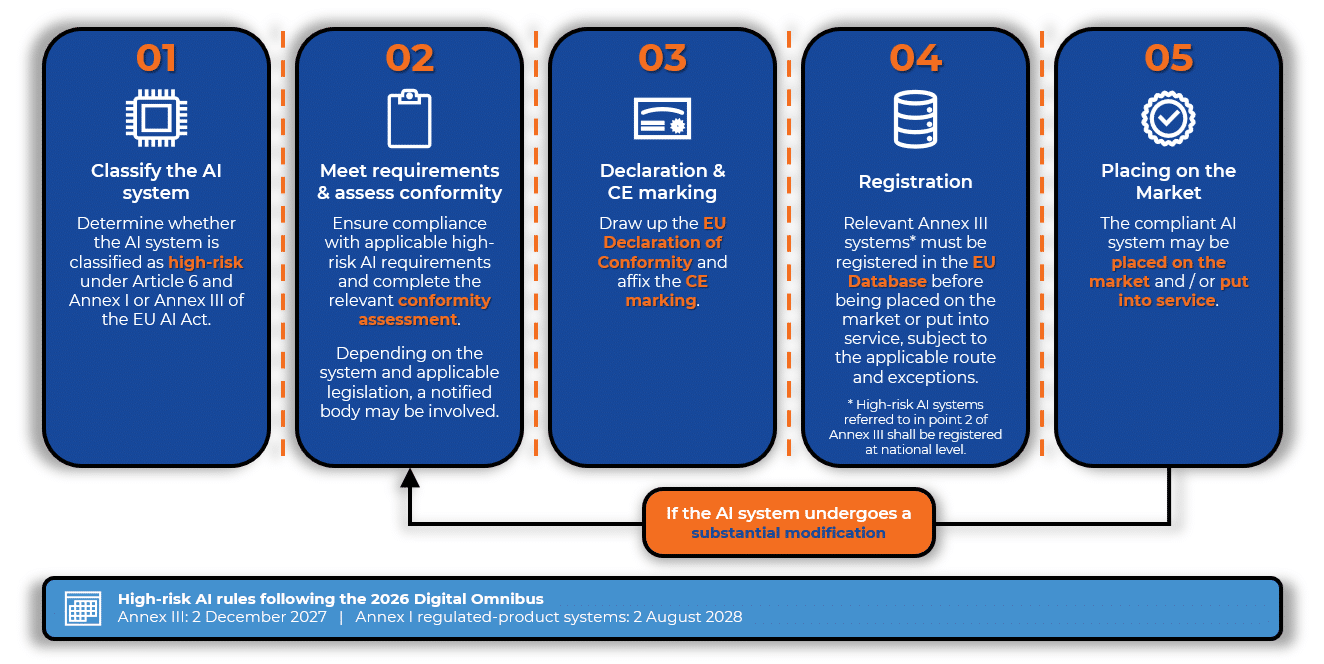
- where stipulated by the Act, before a given high-risk AI system is put into service or placed on the market, a conformity assessment must be carried out;
- put enforcement in place after a given AI system is placed into the market; and amongst others,
- establish a governance structure at European and national level.
The AI Regulatory Framework
The AI Act defines 4 levels of risk for AI systems: Prohibited risk; High-risk; AI systems with specific transparency obligations, and AI systems permitted with no restrictions & which can adopt voluntary codes of conduct.
The Act also introduces requirements for general-purpose AI models.
Requirements for conformity assessment and timelines associated with the implementation of the EU AI Act are further explained in this section.

The AI Act entered into force on 1 August 2024 and applies progressively. Its general provisions, including definitions and AI literacy, together with the rules on prohibited AI practices, have applied since 2 February 2025. The rules for general-purpose AI models, as well as key governance requirements, have applied since 2 August 2025.
As of 2 August 2026, the AI Act started to apply. However, with the Digital Omnibus on AI Regulation coming into force, many of the applicable provisions for providers and deployers with respect to high risk AI system requirements are delayed to 2 December 2027. Therefore, the updated direct application of rules on 2 August 2026 primarily includes the transparency obligations under Article 50, innovation-support measures, and enforcement at national and EU level for applicable rules concerning general-purpose AI models, prohibited practices, transparency obligations and AI literacy.
Further milestones shall have a phased application: new prohibitions and the transitional deadline for certain AI content watermarking obligations under Article 50(2) apply from 2 December 2026; Member States should have at least one AI regulatory sandbox operational by 2 August 2027; the rules for standalone high-risk AI systems listed in Annex III apply from 2 December 2027, and the rules for high-risk AI systems integrated in regulated products covered by Annex I apply from 2 August 2028. The current timeline for the EU AI Act is visualised below: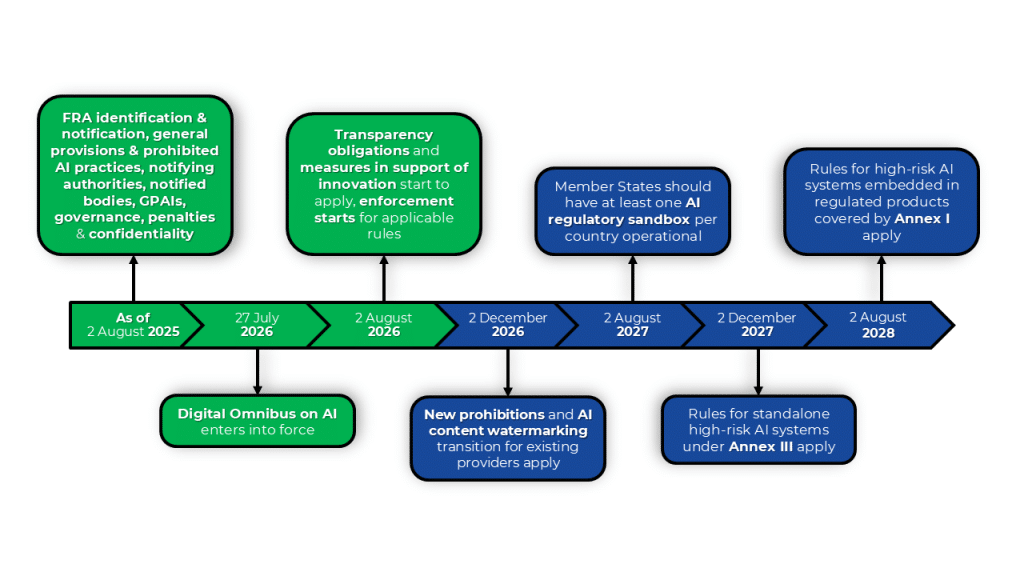
Key Entities and Obligations
The MDIA is leading Malta’s implementation of the EU AI Act and is working with key stakeholders to ensure an effective and supportive regulatory framework.
The AI Act requires the identification or designation of various bodies and authorities.
The main authorities are the Notifying Authority and Market-Surveillance Authorities. Furthermore authorities or bodies responsible for protecting fundamental rights have been identified in line with the requirements of the EU AI Act.
There are six main operators, including, deployer, provider, importer, distributer, authorized representative and product manufacturer.

The AI Act mandates the designation of national competent authorities, in particular at least one notifying authority and at least one market surveillance authority.
By virtue of Legal Notice 226 of 2025 (Artificial Intelligence Regulations), the MDIA is designated as Malta’s lead market surveillance authority, the single point of contact, and the sole national competent authority responsible for the establishment and functioning of a national AI regulatory sandbox under the AI Act.
Legal Notice 227 of 2025 (Artificial Intelligence –Designation of the Information and Data Protection Commissioner for the purposes of Regulation (EU) 2024/1689)) also empowers the IDPC (Information and Data Protection Commissioner) as a market surveillance authority, in particular on AI systems in the domain of law enforcement.
These market surveillance and enforcement powers, including under the AI Act’s national competent authorities, are exercisable as of 2 August 2026, in line with the AI Act’s application timeline (Article 113).
The Malta Digital Innovation Authority shall be designated as the Notifying Authority for the purpose of Regulation(EU) 2024/1689, provided that the assessment and monitoring referred to in Article 28(1) of Regulation (EU) 2024/1689 shall be carried out by the National Accreditation Board (Malta).
Compliance Tools for Responsible Artificial Intelligence
The MDIA has developed a set of practical tools to support stakeholders in understanding, classifying, and responsibly deploying Artificial Intelligence in line with EU and national requirements. These tools provide step-by-step guidance for providers, deployers, and users to strengthen compliance, build trust, and encourage responsible innovation in AI.

Measures in Support of Innovation
The AI Act encourages innovation through various measures, including the establishment of AI regulatory sandboxes. Article 57 of the AI Act delineates that AI regulatory sandboxes shall provide for a controlled environment that fosters innovation and facilitates the development, training, testing and validation of innovative AI systems in controlled environments. Providers in the sandbox are liable for damages but protected from administrative fines if they act in good faith.
The MDIA provides guidance on compliance and risk mitigation, collaborating with DiHubMT, Malta’s European Digital Innovation Hub, which offers support for Small and Medium-sized enterprises and public sector organizations to foster innovation and best practices.
More information on the MDIA sandbox is available here.

Individuals also have the right to submit a regulatory complaint to the MDIA by clicking here